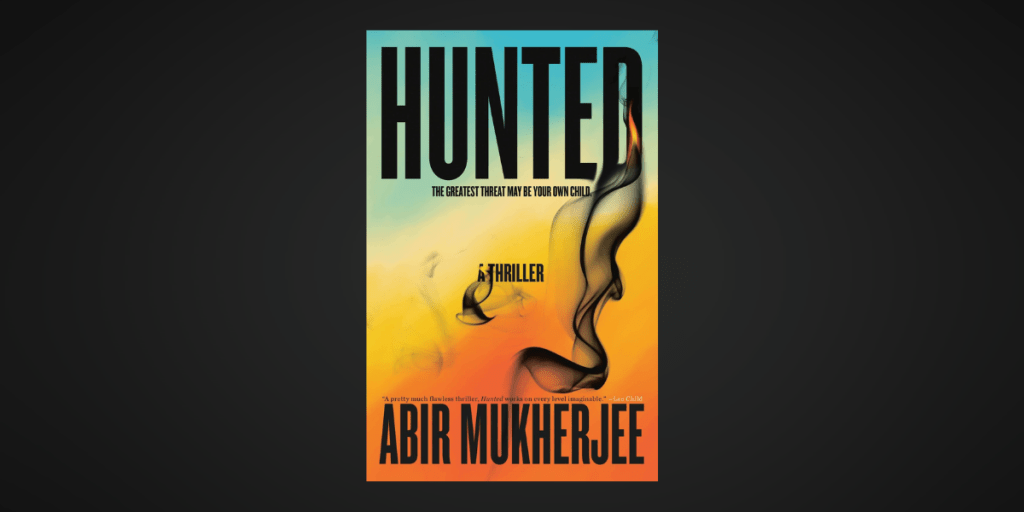
Read the Excerpt: Hunted by Abir Mukherjee
DAY 1
MONDAY
Chapter 1
Yasmin
Nothing good comes without pain.
The chiffon scarf dances around her in the breeze. Yasmin shifts it casually to her shoulders while the world beyond the windshield melts: the carboniferous ghosts of trees yielding to the sprawl of settlements and, in the distance, the contours of the city, its dark lines and needlepoints etched out in the smoke-blue haze of the horizon.
Los Angeles.
The sight of it prickles the soft hairs on the back of her neck as the fear rises within her once more.
She tries to bolster her courage, drawing on a lifetime’s worth of anger.
That’s why she’s here, after all: to make a stand for those who can’t.
Beside her, Jack takes a sip of soda—that’s what they call it here—and in her head she plays with the novelty of the word. He places the can in the hollow of the armrest between them and she reaches out, touching his bronzed fingers with hers, tracing the faint blue outline of the rough tattoos. Jack glances over; her all-American white boy, his eyes hidden behind Oak- leys and his hair under a Patriots cap, but he says nothing. How she wishes he would. A sentence, a word, anything, just to reassure her or …to show her that he too might be scared. His glance though sends a shiver through her. An act that feels illicit. She breathes in the tang of his cologne and turns once more to look out at the vista.
The landscape changes. The dead gradually giving way to the living. Taller buildings now, drawing closer to the freeway; packed in tight like matches in a box.
Billboards and yard signs sprout like weeds: Vote Costa and Take Back America; or Greenwood for President and A Better Tomorrow. Make your mark. Take your choice.
Jack signals, and she feels the car lurch across four lanes of traffic, pitching onto an off-ramp before she’s even had a chance to read the destination on the overhead sign. The soda rocks in its holster, a splash escaping, falling onto cheap black plastic.
“Slow down,” she says. “What’s the hurry?”
Jack looks over and she feels that frisson again. The power of his stare. He brakes for a red, takes a left when it shifts to green and then just cruises, between golden-stemmed palms along a sun-blessed boulevard that stretches on to forever. If this were a movie, she’d have lit a cigarette. Instead she lets the window all the way down and rests an arm on the door sill, fights her rising fear and tries to lose herself in other thoughts.
Everything will change today.
A young mother in faded T-shirt and frayed dungarees propels a buggy along the shaded sidewalk and for a moment Yasmin dreams.
Maybe a kid one day. Maybe even a house.
She shakes the thought from her head. In a few hours’ time, the world will be different and she and Jack will never see each other again. It has to be this way. Miriam has told them so.
They have hardly spoken this morning. Not since leaving the safe house. She, dumbstruck by fear and the incomprehensible magnitude of what lies ahead, and he? Maybe he is being stoic. Or maybe he is just as terrified as her. Two hundred miles and barely a word between them, but now, from no- where, the impulse wells up inside her, the urge to ask him: What the fuck are we doing?
But it is too late now. They have made their decision; decided it together and reaffirmed it in bed last night. Miriam would freak if she knew.
Jack is already pulling into the covered parking lot, taking a ticket at the barrier, pulling off his shades, driving up the ramp.
Too late.
Eighteen years old and already it’s too late.
Jack drives the car nose first into a space and kills the engine. He looks at her and this time she doesn’t flinch. This time it is his turn to place his hand on hers.
“You okay?” The words like balm upon her skin.
“No,” she wants to tell him. “I’m really not.” But that too is impossible. Where she is from, you learn to keep your demons hidden. Instead she nods and consoles herself with the currency of his smile. She is, she realizes, doing this for him. She might have started on this journey out of conviction for the cause, but she is completing it because she’s falling in love with him.
Jack slides off his seat belt. He reaches for the door handle and Yasmin follows suit. She gets out and ponderously pushes the door shut. Jack is already retrieving the trolley cases from the trunk. He pulls up the handle on one, passes her the other and places his shades back on his face.
He takes her hand.
They follow the signs: up stairs, through brushed metal doors, along walkways, passing from parking-lot concrete to the bright, white marble of the mall; crossing the boundary between utilitarian and aspirational. Ahead lie JCPenney, Bloomingdale’s, Macy’s and myriad other stores packed with shoppers seduced by discounted prices and refrigerated air.
She watches them: the sandal-clad parents, eyes flitting between shop windows and hyperactive kids; the tribes of teenagers—the golden ones and the trench-coated goths—loitering near the fountains and attentively ignoring each other; the leather-skinned pensioners in big shirts and sensible sneakers doing laps of the mall like athletes unable to shake the habit; the small-time political surrogates peddling buttons and bumper stickers and politicized baseball caps. Yasmin watches them all with a pang of perfect regret.
She passes the window displays, barely registering the high fashion or high heels that once she might have gazed at longingly.
Jack squeezes her hand. “You want a coffee?” She wants a vodka.
What she wants is something to obliterate the doubts screaming inside her. But that isn’t about to happen. She purges the thought and instead looks at him and nods, not quite trusting herself to speak.
He smiles back. “Starbucks?”
The question is irrelevant. Their route and actions have been planned in advance. The question is part of the routine and the routine is for the security guards and CCTV cameras.
He leads the way, as confident in his direction as though he were walking home from the bus stop, through an eddy of kids and into the glass-domed atrium, joining a stream of shoppers ascending golden escalators toward the gates of the food court. He lets her step on first, standing behind her and encircling her waist with one strong arm as the stairs rise, and for the small- est of moments she wonders whether that arm protects or constricts. She turns round, the extra step negating his extra height, and for once they are level. A wave wells up within her, a bittersweet rush that encompasses everything from love and exhilaration to pain and pitch-black fear.
She clutches the escalator belt and feels like throwing up.
The landing appears ahead, bright and white. Jack takes the lead and once more she follows him, dutifully.
She wonders what he is thinking.
Does he too have doubts? How could he not?
Jack orders lattes while she waits for a table, loitering close-but-not-too- close to an old couple who sit hand in hand in front of empty cups. They are silent, yet Yasmin senses that a whole world of words passes between those thin, mottled fingers. By the time Jack returns, the table is hers. Instinctively she lowers her gaze, just as Miriam would want it. He places the black plastic tray on the table and takes the seat opposite. A cookie sits alongside the lattes. A gingerbread man with glazed eyes of icing sugar.
Last chance.
What was it they said at Christian weddings? Speak now or forever hold your peace.
But she can’t speak. She certainly can’t look at him, fixing her gaze instead on the china mugs and the oversized biscuit.
Too big.
Everything in this country was too bloody big.
She reaches out, searching for the warmth of his hand and finding noth- ing but bare table.
What is he feeling? Surely he too must be scared?
She feels his touch, his fingers upon hers, and looks up at him and sees the nervous energy in his face, the electric charge ripple across his shoulders.
He is, she decides, dealing with his fear in his own way. “It’s okay,” he says. “We’re nearly there.”
He lifts the gingerbread man from its saucer, breaks it in two and holds one half out to her. She takes it and stares at it: a head and half a torso.
“Jack.”
He looks up from a sip of coffee and her confidence evaporates. “Do we have to …you know …?”
“Baby,” he says, rising from his chair and taking a seat on the bench beside her. She feels the strength of his thigh against hers. “You know we have to. It’s the right thing to do. And when it’s done, we’ll be together. Don’t matter what Miriam says, we’ll make it happen.”
His words soothe her, but they don’t silence the screams that swirl in her head. And he’s right, of course. They need to keep going. Someone has to. Someone has to strike a blow.
Jack takes another sip and places the cup back on the table. She watches as he clenches and unclenches his fists.
“It’s okay to be frightened,” he says. “I’m scared myself. But it’s like Miriam said, we need to hit back at these bastards.”
She looks down, her eyes falling on the trolley case beside her. She thinks of its contents, which she has never seen.
She picks up her cup and sips, swallowing hot coffee and registering only the burnt, bitter aftertaste. She contemplates a bite of her half of the ginger- bread man but doesn’t have the appetite.
“You clear on what to do?” She nods.
“Good,” he says, then rubs the back of his neck and reaches over. She feels him thread his arm with hers. He squeezes her fingers, then kisses her and she doesn’t know what to feel.
“It’s time,” he says softly.
The kiss seems to renew her courage. Suddenly she is on her feet, going through the checks as though on autopilot. She knows the drill. They have practiced it. Jack is already heading out into the mall. She will wait. Two minutes only. Enough time so that he can lose himself in the crowd. She spends the seconds clutching the handle of the trolley case, wheeling it forward and back.
Two minutes. It had seemed longer during the tedium of the dry runs, but now it is over too quickly.
She pulls the case behind her and sets off, joining the sea of bodies making for the escalator. She heads down, past carefree faces going the opposite way. It hurts to look at them, so instead she stares at her feet.
Three minutes to reach the prearranged location: the landing outside the radio station; the shock jocks broadcasting their poison into a million minds. Odd that the station should be in a mall, but then its positioning is one of the reasons Miriam has chosen it as a target.
“It’ll send a powerful message.”
Jack will be inside by now, in the reception area. At least that is the plan. She is not to enter, just plant her bomb in the hall outside and wait among the crowds for him to plant his and return. They will make their way back to
the car and drive a safe distance and then phone in the warning.
“No innocents will get hurt.” Miriam has been categorical about that, and she has faith in Miriam; absolute faith.
But then she triggers the sensors on the automatic doors. They open. Jack is not there.
She hesitates, hovering on the threshold, peering into a different world from the throng of the mall beyond: a world of white, antiseptic light; of sofas and flat screens and blonde receptionists behind a gleaming desk. She stands there, a stone in a stream, as crowds of shoppers brush past, their voices crashing in on her, drowning her own thoughts. A security guard is already assessing her for signs of threat. But there is no sign of Jack. Where is he?
She steps back and collides with an old woman in sunglasses and sneakers. She mumbles an apology but with one eye still scanning for Jack. Her heart is pounding. She needs to keep calm. He must have been waylaid. The mall is packed after all. But long minutes pass and still there is no sign of him.
She tasted salt on her upper lip.
Is he lost?
But Jack would never make that sort of error.
Maybe she is in the wrong place?
She turns, frantically scanning the floor for another entrance to the radio station, but there is none.
The black fear begins to well up again, threatening to overwhelm her. She keeps looking for Jack, searching for his dumb shades and his stupid baseball cap.
Has he been arrested? Is it all over before they’ve even started?
But she has watched the videos, the clips on YouTube of screaming onlookers and their panicked, herd-like stampede away from trouble. If they have got him, then where is the commotion? Where are the shouts of frightened shoppers, and where are the cops with their guns?
As one thought recedes, another takes root: darker, more pernicious.
Has he had a last-minute change of heart?
Has he decided that, after everything, this wasn’t what he wanted? But then, why wouldn’t he tell her? An electric panic seizes her.
Where the hell is he?
Her breath comes fast and shallow. She tries to force those last, terrible thoughts from her mind, but they flood back like storm water bursting a levee. She gulps at the suddenly thin air and feels the stares of passers-by boring into her soul, sensing her fear. Knowing her guilt.
She reaches into her jeans, takes out the phone Miriam has given her and dials his number from memory. No saved phone numbers. They have been strict about that. She waits for it to connect, agonizing seconds spent in the hope that he will pick up, but it just keeps ringing till she hears the computerized lilt of the phone company’s voicemail, asking her to leave a message.
Fuck that.
She cancels the call and slips the phone back into her pocket. Something is clearly wrong. The plan is quite specific: plant the bombs and leave together. She cannot get out of here without him.
She doesn’t understand.
Frantically she searches for somewhere she can dispose of the case: an exit, a toilet, even a bin for fuck’s sake.
Then she remembers the corridor, the concrete stairwell to the parking garage. It would do. She runs, wheeling the case behind her, fighting through the crowd, ignoring their protests as she barges past.
She can see them now, the brushed metal doors just a few hundred meters away. She runs on, closing the distance: four hundred yards, three hundred. She feels her phone vibrate.
Jack. It must be Jack.
She slows to a walk, pulling her phone from her pocket. She does not recognize the number, but it doesn’t matter. Whoever it was has ended the call and suddenly she knows it’s too late. She hears another phone begin to ring.
It is inside her trolley case. She doesn’t know what it is and at the same time knows exactly what it means. Yasmin Malik drops the phone in her hand. She thinks of her brother and begins to recite the declaration of faith. “There is no god but God and Mohammed is his—”
And then the bomb in her case explodes.
Chapter 2
Shreya
Shreya Mistry longed for a cigarette. A nicotine punch to numb the shock of the carnage, but she’d tossed the last pack months ago, and anyway, it was out of the question on account of gas leaks.
There was no logic to it. At least none that she could see. No rhyme. No reason. Just victims dead and dying.
The air tasted of charred plastic and industrial solvent; of sackcloth and ashes. No more flames now, just smoke that billowed thick and black and impenetrable and mushrooming into charnel-house clouds.
She threaded her way through the cordon of emergency vehicles; lights on their roofs dancing kaleidoscope red and blue, triggering that familiar fizzing in her head. She looked down at the ground and centered herself. Around her the first responders: firefighters, police, paramedics; all just bystanders and stretcher-bearers now, traversing a parking-lot no man’s land of twisted metal and crystalline shards of glass; ferrying the dead like battlefield orderlies.
She shouldn’t be doing this.
She should be keeping her distance like they were told to, like the others were doing—the ones who didn’t obsess the way she did, the ones whose careers were still moving forward.
Good for them.
She kept walking, heading for the entrance, past the painless faces of the dead lined up in rows on the ground. As for the injured, the bloodied, the traumatized, she avoided their eyes. Behind her, sirens wailed and people cried. She shut out the noise and filled her head with numbers. Sixty-three dead. A hundred and fourteen injured. Fifteen years at the Bureau. Fifteen years, and four months. Yet this was a first.
What sort of people bombed a mall?
A mall, in the middle of the day, when it was full of nothing but old folks and kids and store assistants working for minimum wage. And it was a bomb, confirmed now, though obviously she’d anticipated it from the start—as soon as the alert had reached the Bureau; fears that had festered and brooded, that had sat in her stomach and multiplied as she and half the field office had sped to the scene.
What sort of people bombed a mall?
The question wasn’t just rhetorical. She listed the candidates. Hard left and far right. The Global Action folks, saving the planet by blowing up bits of it, or the American Redemption fanatics, looking to bomb America back to greatness.
In a sense it didn’t matter. The dead didn’t care and most everyone else would utter thoughts and prayers and then believe whatever post-truth palliative they wanted.
She donned a mask and latex gloves and approached the entrance.
“You can’t go in.” A thick hand, shoved in her face by a sweaty cop. “Building’s structurally compromised. Whole place could come down at any minute.”
She showed him her badge. Held the photo ID close to her own head in case he was one of those who had trouble telling one brown woman from another.
The cop gave a shrug.
“No one goes in till the engineers say so. Don’t matter who you are. I got my orders.”
“And I’ve got mine,” she told him.
A lie. It made the hairs at her neck prickle. Lying was difficult, though she was getting better at it. The trick was to shut down your brain and try to look people in the eye as you said it. But then eye contact was another challenge, in its way just as problematic as lying. She steeled herself, then stared at the officer, gazing at him with the zeal of a Jehovah’s Witness on the doorstep till he backed down and stepped aside.
“Fine,” he said. “It’s on your own head.” She hoped not.
*
The first couple of yards inside, it was hard to tell what had happened. The place appeared untouched; outlets and convenience stalls pristine and desolate as though just waiting for opening time. Only shattered glass and the litter of bags and backpacks—the detritus of the fleeing—pointed to what might lie ahead.
Yellow tape presaged the route. Her colleagues would have been in here already, hot on the heels of the first responders; gathering what evidence they could before being evac’ed out once the structure had been deemed unsafe.
She shouldn’t be here.
The story of her life.
The noise, the chaos of the parking lot faded, yielding to a singular silence. It struck her as odd that the pain and the grief out there had been born in here, conceived in terror, a malign force that had migrated, leaving behind it a wasteland. She kept going, the only living thing in a world of mannequins, her footsteps echoing on polished floor tiles.
She closed her eyes, savoring the peace for a moment, before abruptly opening them again, reminding herself that that was not a fitting reaction.
She turned a corner and everything changed: sharp, ordered white dissolving to chaos and charcoal black and the stench of charred flesh and rubber; a jagged, bloodstained mess of twisted metal and tangled electrical cables; of dust and rubble and the ghosts of lives cut short. She closed her eyes and counted. It often helped. Safety in numbers. One, two, three …A ten count was normally enough. Today it took close to thirty. She took a breath and opened her eyes to a different world; the Third World. Iraq or Libya maybe, but with sneakers in place of sandals.
Ground Zero.
She knelt to recover a child’s doll, a Raggedy Ann–type thing like the one Nik had told her to buy for Isha years ago, when the girl was still a baby. She turned it over and stared at its charred and puckered face then placed it back on the floor and considered the blast radius.
Large. A sophisticated device.
She took her bearings. A service entrance nearby. No stores particularly close, no obvious target, at least not that she could see. A strange place to set off a bomb. A couple hundred yards away, a more central location, and the casualties could have—would have—been far higher. Whoever had done this had been …inefficient.
Her lungs burned, bronchial tracts constricting from the fog of bomb debris and asthma. She raised a hand to her mask as the coughing fit bent her double; a febrile twenty seconds that felt like life-sapping minutes. She beat back the panic, visualized what was going on in her chest just like she’d been taught, till the fit passed, then straightened to ringing ears and wet eyes and dancing pinpricks of light. She wiped them away and stared up at the ceiling: at the small blinking light on the black dome of a security camera.
The building groaned. An iron gasp of despair. She should leave now.
Before the whole place decided to come down.
That camera.
It might have caught something …
She found a mall plan—a diagram etched out in happy colors showing shops and levels and stairs—and committed it to memory. The work of seconds. No mention of what she was looking for, but malls like this generally housed their brains in their basements. She made for a stairwell, down concrete steps to a bunker of offices vacated in a rush. Lights on. Laptops running. An office plan taped to a wall directed her along a desolate corridor that fell in and out of sight to the beat of a flickering striplight, past bulletin boards and motivational posters, to a door at the end. A cursory knock and then she pushed it open, stepping into a room that stank of fast food and cheap deodorant.
A bank of screens flickered across one wall; a patchwork of images, twelve inches square, displaying all corners of a hollowed-out mall. In front of them, consoles that looked salvaged from a TV cutting room: all keyboards and knobs and dials.
There should have been agents here. There should have been men and women, checking faces, crawling over camera footage, but there was no one. Dan was playing it safe, waiting for the all-clear from the structural engineers; but then he’d been playing it safe his whole career. That was why he was station chief now while she was—what exactly, other than a pain in everyone’s ass? And that’s why she was down here now while Dan and the others were outside.
Old security systems like this one were simple enough to operate—just logic and trial and error. She pulled over a creaking office chair and sat down in front of the console. Finding the right camera wasn’t hard: it was the one showing an image of stark and absolute destruction. A couple of keystrokes brought up a menu. A few more and the footage spooled backward, shimmering like mercury. She kept going till the picture changed—the devastation of a bomb site morphing into fog and then fitting itself back into structured reality.
Order from chaos.
She pressed a button and the image rippled and froze. In the center, a girl in T-shirt and jeans and holding a wheelie case had just dropped her phone. It hovered halfway between her hand and the ground.
Another key-press and the image shuddered to life, the action reversing like some manic comedy clip: the phone jumping back into the girl’s fist before she took off, rushing backward toward the center of the mall and out of shot.
Why was she running?
Shreya toggled cameras and found another angle, rewinding the footage to the point where the girl came into shot. Was the girl scared? Shreya wasn’t exactly the greatest at reading facial expressions but even she recognized fear when she saw it.
The girl continued her backward run across the concourse, past window shoppers and families and kids before stopping beside the fountain in the middle of the atrium. The perfect place to let off a device.
Shreya bit at her lip.
Dead center. The girl had stood right there. And yet she’d run for an exit, only to stop and answer her phone seconds before her bomb exploded.
Why?
Shreya wound back further, slowly, incrementally, following the girl across screens and back in time; back to outside what looked like an office; back to the food court; back into a Starbucks; back to a table and to some guy in sunglasses and a baseball cap.
Who was that?
She felt the floor judder. Metal groaned.
She should leave . . .
She looked to the ceiling, then back at the screen.
She couldn’t. Not yet.
She pressed rewind, tracing the two of them walking backward hand in hand: back down the escalator and through the mall, back toward the door to the service area the girl had been making for when she’d stopped and the device had exploded. The guy in the baseball cap seemed to know where the cameras were. He walked with his back to them or, when that was impossible, with his face shrouded by his hat. They went back through the door to the service area and Shreya searched for the feed from the camera in the corridor beyond, finding it and once more going through the whole pro- cess of reversing time to the point the two passed through.
Her eyes flickered. She pressed a button to freeze the footage. The girl stood motionless, fingers pressed against the steel plate of the door, caught in the act of pushing it open.
There.
The merest of smiles crept onto Shreya’s face, just as the ceiling cracked and the first shards of plaster rained down.
She leapt from the chair and ran. Out of the room, back along the corridor as the building roared. The noise …it filled her head …disorienting …Which way was it? Left or right? She chose left. She always chose left.
She sprinted as the dust fell, as the walls around her shuddered, searching for the familiar: the water cooler; the staff chart on the wall with the faces of its employees staring out like mugshots on a wanted poster.
She burst through the doors into the stairwell. The building screamed; the death throes of a wounded animal.
Not enough time to head upward.
So she headed down, running further into the bowels of the building, making for the basement parking lot with its forest of reinforced concrete pillars; down the stairs as the lights flickered then failed around her; taking them two at a time, into the darkness, her breath ragged now, her windpipe constricting.
She shouldn’t have come down here. She should have listened to the cop on the door.
The edges of her vision clouded. She burst through the doors and into the parking garage as a tsunami of rubble and dust and plaster crashed toward her. And then the world dissolved.
Shreya saw her late mother. Arms folded. Face set in a semi-permanent scowl that was both accusation and damnation.
“What did you expect, Shreya? A happy ending? After the choices you made? ”
Was this karma? A fitting end. A life crushed under rubble. “Why, Shreya? Why the FBI?”
It wasn’t like that, Mom.
What did the woman want? An apology?
“Shreya?”
The voice changed, her mother’s plaintive tone supplanted by another just as familiar, just as grating.
“Shreya? Can you hear me?”
The voice grew louder in the blackness. In her head she swam toward it, suddenly conscious that she was lying flat, horizontal amid the void. With an effort she wrenched open her eyes to white light. Bright. Uncompromising.
The taste of blood on her lips. “Shreya?”
The world resolved into focus. Striplights: harsh, hospital white. She raised a hand against them. The grooved metal ceiling of an ambulance. The sharp tang of disinfectant. Dan kneeling over her, his face contorted in an expression she couldn’t fathom.
Dan.
She tried to sit. A forlorn effort, swiftly abandoned with a billowing wave of nausea.
“Dammit, Shreya …”
The rest she couldn’t follow. The words struggling for space and meaning amid the roaring that filled her head; her thoughts muddled, mired in fog. Among them, something important. Something she needed to tell him.
“You could have fuckin’ died, Shreya. You’re lucky some cop you mouthed off to remembered you, otherwise we wouldn’t have known you were even in there.”
She looked up at him, the buzz in her head growing as she made eye contact.
“And you said my mouth would be the death of me.”
“Screw you, Shreya. What the hell did you think you were doing in there?”
That was it. That is what she had to tell him.
“Checking the security footage. I think I found something.” “What?”
His expression changed to one of …surprise, she guessed. It was gratifying. She liked it when she confounded him. It made up for nearly getting killed.
“The bomber,” she said. “It was a girl …a young woman. She came in with some guy but carried out the attack alone …And she left prints on the door from the parking lot. The exit nearest the blast site.”
She had to show him. But things had changed since she’d watched the
security footage. Half the building had collapsed. Would that door even be there now? She needed to get her bearings; tried sitting up, but her ears pounded and the world began to spin and then she collapsed into darkness once more. In her mind, Shreya saw the girl: running across the mall …stopping …reaching for her phone …
Dying.
DAY 2
TUESDAY
Chapter 3
Shreya
Why had she been running?
The shrill tone of the telephone shattered her introspection. “Shreya. Get in here.”
Dan’s voice, rough as a Mexican cigarette.
She rose gingerly from her chair and walked from her cubicle—temporary, just till they could find her something more appropriate, but it might take a while— crossing the floor to the clamor of an office animated by crisis. A twinge in her back almost stopped her in her tracks: a memento mori from the mall—a reminder of the constant and casual proximity of death. The doctors had discharged her, insisted she go home from the hospital—and she had done so, for six hours, till the pull of the office and the pang of unanswered questions had become too strong. She had gone in to the Bureau to join caffeine-fueled colleagues coming off the back of an all-nighter. That’s just how it was with terror attacks. No rest for anyone till a breakthrough was made. Add a toxic presidential election into the mix and the situation was, as Dan would say, a shitshow.
That was eight hours ago. Now the man himself stood at the threshold, a brick wall dressed in yesterday’s shirt and tie with one solid hand on the door frame like he was steadying it. He ushered her in with a glance and closed the door behind her.
She took a seat in front of his desk, beside his bookcase of heavyweight texts with gilt-etched titles, and looked straight ahead at the bunch of framed certificates hanging on the wall like papal bulls yellowing in penance. Dan retreated to the other side, to a swivel chair that complained under his weight, pressed his palms together and made a show of studying her face, an act which only made her uncomfortable.
“How you feeling?”
Like crap.
“I’m good.”
“You sure? You need some time off?”
“No …boss.”
She threw the final word in, gratis. Dan seemed to like that sort of thing. “You want a coffee?”
She didn’t want a coffee. She wanted to know what they’d discovered. He sensed the question and answered it with a nod.
“We found the door. We even got prints. Her name’s Yasmin Malik.” Fast work. The door to prints, to an ID, and all in the space of twenty-four hours. Impressive what could be achieved with the director and the whole political establishment breathing down their necks.
“Her prints were on file?” A shake of Dan’s head.
“Not exactly. She’s not American. She’s British and a Muslim. They took her prints when she entered the country.”
“We know anything about her yet?”
A grunt prefixing his reply. “It ain’t pretty. A girl with a shitty past. Dad died young. Mom diagnosed as bipolar. Taken into care. A history of absconding, a record of petty theft. Last recorded as staying at a women’s refuge south of London. She had one brother, two years older, taken into care at the same time. He ended up joining IS in Syria; reported killed in a U.S. air strike.”
Yasmin Malik sounded like a poster child for radicalization.
“Homeland Security has her arriving at Portland International on a flight from Dubai about nine weeks ago. She took a flight from London and changed there.”
Nine weeks was a long time. “Where’s she been since then?”
A question answered with a shrug. “Anyone claimed responsibility?”
“No comms chatter. At least none that the CIA or NSA picked up, but an outfit calling itself the Sons of the Caliphate sent a coded statement to the Washington Post claiming credit.”
The name was unfamiliar. “Some Islamic State affiliate?” “Search me.”
“Any demands?”
“Just the immediate release of all remaining inmates at Gitmo. Apparently there’s thirty to forty of the bastards still being held there.”
Shreya blinked. Twenty years at Guantánamo without a trial. She bristled at the thought, not out of compassion or regard for the incarcerated but because of the contradiction. It was un-American.
“Anyway,” Dan continued, “the president ain’t about to release them, not now, not in response to a bomb attack and an ultimatum from some group no one has ever heard of. It’d be political suicide.”
“So more attacks?”
He gave a nod. “Look at the timing. Unless we find them fast, my guess is more bombs, more dead Americans before Election Day. Still, I guess it’s nice to have some good old-fashioned Islamic terror again. Makes a change from all the fuckin’ home-grown nutjobs of the last couple years.”
She couldn’t see why that might be preferable. Was he making a joke? She never could tell. In any case, she didn’t question him. She was too busy considering the ramifications. A Muslim girl carrying out the largest attack on
U.S. soil since 9/11, eight days before an election resting on a knife edge. That was a material event, a paradigm shift, or as Dan might say …a fucking disaster. It had the scope to change the outcome.
Dan wiped a hand across his forehead. “The AG is having a meltdown.
It’s the hard right’s wet dream.”
This she understood, even if the description grated. From talk-radio jocks and alt-news hosts to evangelical preachers, this would be manna from heaven.
In times of trouble it was always easier to peddle fear than to preach tolerance. And the Dems would respond by doubling down too, falling over themselves to show how tough they were on terrorists—the foreign kind, at least. And that would mean even more pressure on the Bureau to catch—and kill—whoever was behind this.
Why was she running?
The question surfaced unbidden once more, a cork bobbing in the maelstrom of her mind.
“We need to consider other options. We can’t just assume it was Islamist,” she said, “not yet.”
He shot her a look that made her brain hurt.
“Don’t start, Shreya. Would it kill you to just for once accept things at face value?”
Face value. But that’s what she was doing. She’d seen the look on that girl’s face.
“The girl was scared, Dan. She was trying to get away. You need to look at the footage.”
“And I will, just as soon as we can get to it, assuming there’s anything left under that mound of rubble they pulled you from. Right now, though, the working assumption is Islamic terror and that seems right to me. She wouldn’t be the first suicide bomber to get cold feet.”
“Nor the first to be coerced into something against their wishes.” He gave a sigh.
“We’ve been here before, Shreya. Why do you need to question everything?” She felt the first prickle of heat on her neck. She didn’t question everything. She just had a problem with people doing half a job. Why couldn’t he see that?
“So I should just shut up?”
He shook his head in that way that people did when they thought she was being difficult.
“Why can’t you just accept that your colleagues aren’t all idiots? Based on the threats received and the proximity to the election, we’ve got to assume the threat is jihadist and that another attack is imminent.”
“I don’t think they’re all idiots.”
“I’ve told you before, Shreya, you need to learn when not to speak. Discre- tion is the better fuckin’ part of valor. Or hadn’t you heard that?”
She nodded.
Of course she’d heard the expression. People had been saying it to her in one form or another for as long as she could recall. It sounded like cowardice.
“So what do you want me to do?”
He stared at her, just a moment too long. His voice suddenly softened. “Shreya, this case is not going to be your concern. You’re being transferred to San Diego.”
“What?”
“Orders from on high.”
There had to be some mistake.
“But I just spent eighteen months down there.” “Maybe they thought you were doing good work.” Once again she couldn’t tell if he was joking.
“Is this because of yesterday?” He gave a grunt.
“Look, Shreya, I guess they need the manpower. Drugs and immigrants floodin’ across the border like it isn’t even there; and if Costa gets in, well, you can bet he’s gonna head down there every chance he gets for a photo op. Fuck, we’re lucky he hasn’t suggested declaring war on Mexico just for the bump in the polls.”
She couldn’t help but think there was more to it. That was the problem when you spoke your mind. You pointed out some hypocrisy, some double standard of the folks who ran the place, and suddenly you became the problem.
She looked back at Dan.
“The girl, Yasmin Malik, she was South Asian. If there are more attacks coming, then you need me on this. Who else is gonna give you the kind of insight I can?”
He spat a laugh. “This ain’t 2004 anymore, Shreya. You think you’re the only South Asian in the Bureau? There’s plenty of others and most don’t come with your …baggage.”
“Or my experience.”
“Experience that told you to walk into a building that was about to col- lapse? You know how much fucking paperwork I’d have had to deal with if you’d died?”
“I got a result.”
“You still shouldn’t have gone in there.” “But we needed to find out what happened.” “We? Or you?”
“Dan, let me stay on this case. I’m expendable. I can get things done for you. If it works out, you take the credit. It all goes to crap, you got someone to blame.”
He should have gone for it. He should have thanked her. She felt he would. It was the logical option, after all.
“Fuck you, Shreya. I don’t need credit, and I don’t need to be pulling your ass out of the rubble of a building.”
He gave a sigh.
“It’s out of my hands. Take the rest of the week off. Just make sure you’re down in San Diego by Monday.”
Outside the world reduced to smears of movement in her peripheral vision.
San Diego. Again.
They might as well have handed her a gun and a glass of brandy and told her to do the decent thing. It was hardly fair on the San Diego Bureau either. They weren’t exactly going to be throwing her a welcome party. Shreya Mistry—Shreya Misfit—an agent without a home; a problem without a solution.
She should have told him to take San Diego and all his patronizing BS and shove it up his …She left the sentence unfinished. Profanity was difficult, even within the confines of her own head. Another agent might have resigned there and then. Maybe she should have. But what else did she have besides the job? A broken marriage? A teenage daughter she hardly ever saw?
No, it was better to sit there and take the crap; to listen to the man in authority.That’s what a smart woman always did, wasn’t it? Defer to the man, even if he was just the right side of mediocre.
She stared at her reflection in the door’s plate glass. She looked tired. She looked old. What had happened to her? Hadn’t she once been the face of a new, improved, multicultural Bureau, tipped to be fast-tracked to the top?
How did it all go so wrong?
Dan, in his more bellicose moments, put it down to her personality, her inability to follow orders. It wasn’t true. She could and did follow orders, just not the dumb ones.
Whatever.
There was no point in dwelling on it. She’d fought those battles and lost. Been frozen out and forced sideways. In Russia they’d have sent her to Siberia. Here, they’d seconded her to San Diego.
The image of that girl haunted her head once more. That and the guy who’d brought her, who’d kept his face shielded from the cameras. Who’d left her there to die.
Why was she running?
Dammit. That wasn’t her problem anymore. San Diego—now that was her problem.
Her cellphone buzzed. Her father.
“Dad, what time is it there?”
“It doesn’t matter. Old men don’t sleep. I was watching the news. You are okay?”
“I’m fine, Bapu.”
Her neck burned. The heat that came from telling a lie. She rubbed it, but it did no good. It never did. Lies were always difficult, and white lies, for some reason, the hardest of all. Best to change the subject.
“How are you? You making friends? How’s Mrs. Wilson down the hall?” “Friends? Jah! She wants me to do bingo and line dancing. Isn’t it bad
enough that I’m in this place? Must I also do bingo?” “She likes you, Dad. She’s just being friendly.”
A sigh on the other end of the line. “It’s not our way, Shreya. It’s unseemly.”
“It’s been over a year. You can’t mourn for the rest of your life.” “Your mother would have, if it had been the other way around.”
That was true, but that was her mom, perennially suspicious of anything not in lockstep with the values and prejudices she’d been raised with. She’d have taken up the role of a widow, wearing white and eating only vegetarian food, with the zeal of a martyr.
Still, her father had a point. The thought of him being cajoled into extra-curricular activities by an old white woman in a retirement home struck her as wrong, somehow. It wasn’t how an Indian man expected his autumn years to turn out. He should be surrounded by family and grandkids.
“Aren’t you always telling me to try to fit in, Dad? Maybe you need to do the same?”
“I’d rather be dead.”
She closed her eyes. Her late mother’s penchant for melodrama, reincarnated in her father.
“I might have some leave coming up. I’ll try and fly over.”
Not a lie. A half-truth.
“Will you bring Isha?” he asked. “She said she might come for Diwali. I haven’t seen her since her birthday.”
Shreya could have said the same. Six months since she’d last seen the girl in the flesh. What was it, a month since the last phone call? Why had it been so long? Granted, she wasn’t the most loving of mothers—the sort of mother-daughter intimacy of soap operas and the school gates had always been difficult for her—but she could and should make sure the girl knew she was there for her. At least she was still living with her dad, even if it was with him and that new woman of his. She felt a jolt of something in her gut, like a stone dropping down a well.
“I’ll speak to her, Dad, and see what I can do.”
On the TV screens, helicopter images of the ruined mall played on repeat. A Muslim girl from England, lying low in America for nine weeks before setting off the biggest bomb since Timothy McVeigh. Where did she even get a device like that?
Her laptop pinged. An email marked San Diego: Relocation.
To hell with that.
Shreya reached for her phone, brought up a Washington number and pressed call. It would be late evening there. Still, she took a chance.
A voice eventually answered. “Luca. It’s Shreya.”
“Shreya? Oh God. How do you even have this number?”
She cut him off.
“I need a favor”
About the Book
A Washington Post Best Thriller of the Year
An Amazon Best of the Month Mystery & Thriller Pick and an Amazon Editors’ Personal Pick
In Florida, a mother makes a connection between her son and the bomber, fearing he has been radicalized.
And in Oregon, an unknown organization’s conspiracy to bring America to its knees unfolds…
On the run from the authorities, the two parents are thrown together in a race against time to stop a catastrophe that will derail the country’s future forever.
But can they find their kids before it’s too late?
For fans of The Chain and I Am Pilgrim, this ground-breaking, blockbuster thriller is unlike any other thriller you will read this year.