Author Interview: Jonathan Jakubowicz on Writing a High-Stakes, Politically Charged Crime Thriller for the Century
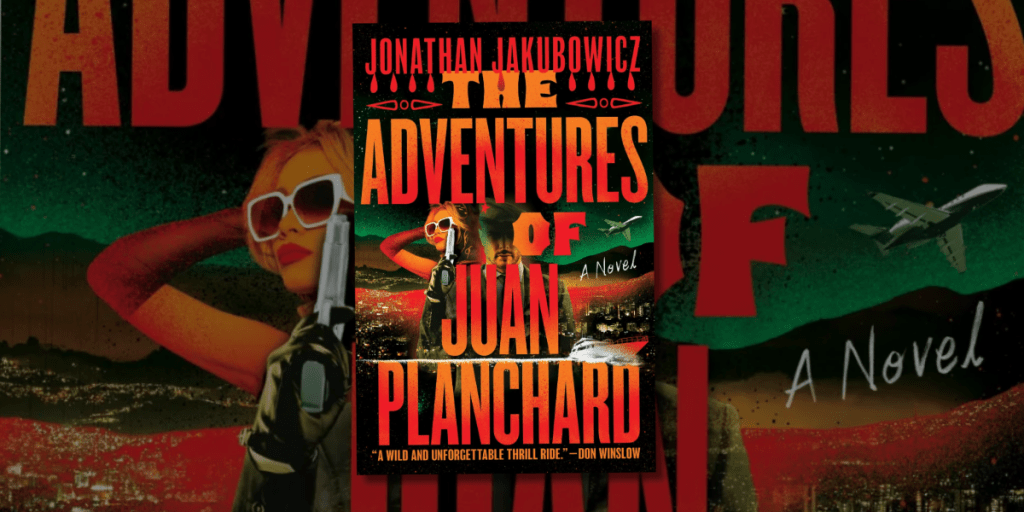
Author Jonathan Jakubowicz has answered some of his novel’s most pondered questions in this fast-paced ride through sex, drugs, and revolution: The Adventures of Juan Planchard. Keep reading to get insight into the creative mind behind this wild novel.
The Adventures of Juan Planchard follows a middle-class man turned millionaire who falls for woman who may or may not be his downfall. I’m sure you’ve heard the age-old adage, all stories are love stories. Do you agree?
Juan is a mad romantic. You could argue that Scarlet is both his downfall and his salvation. I always saw him as a Shakespearean character: a good man doing bad things. Scarlet gives him hope, a way out of the prison of wealth and excess he built around himself.
There’s a lot of political themes embedded in The Adventures of Juan Plachard, especially around Venezuela, where the novel is set. Did you set out to create a book with such biting political commentary or was that the direction your character, Juan Plachard, took you in?
I started writing Juan because I saw a complete disconnect between what my fellow Venezuelans believed the revolution was and what I watched it become with my own eyes. Everyone saw socialism; I saw the biggest heist in history. I went deep into my research to understand how a massive robbery could be carried out in the name of equality and justice. Juan Planchard is a composite of real people I met along the way. The political commentary emerged naturally from exposing a truth that many once dismissed as exaggerated, but that time ultimately revealed to be undeniable.
You have a colorful background as an acclaimed filmmaker, so we have to ask: How did that inform your writing process?
I think it has to do with the pace of the storytelling. Films have to move faster than literature, and I’ve been writing movies for so long that my book moves at a speed that is rare to find in a novel. In film, we see it as our job to make sure the audience is never bored or distracted. I believe I brought that into Juan Planchard. A lot of readers tell me they finished it in one sitting, and that makes me so proud. There’s nothing I love more than when a book does that to me.
Juan Planchard is a fascinating protagonist to follow. He demonstrates an honest, and often lewd, side of wealth and political corrupt. What were the ingredients that came together to help you shape such a compelling antihero?
I studied journalism at a public university in Caracas. Some of my professors and classmates were poor idealists who played an instrumental role in bringing Hugo Chávez to power. A few years later, I saw them swimming in wealth. People who couldn’t afford a car suddenly owned yachts. When you are a filmmaker, people are often willing to tell you their secrets because they want you to make a movie about them. And because I knew them from before, it was easy to get them to trust me with their stories. Juan Planchard is a combination of them. He rationalizes crime in ways that are both convincing and shocking, and I think that’s why he’s so fun to read.
What’s next for you? Are you planning on writing any more books?
I just finished the third part of the Juan Planchard saga. English-language readers will get the second installment next year, and the third will follow after that. It begins in 2025, with Juan playing an instrumental role in the events that we’ve seen unfold in Venezuela over the last nine months. I think it’ll answer a lot of questions that arise from the incomplete information people get through the media. Whether it’ll be the last in the series depends on what happens next in my country. I’m hoping it’ll just be a trilogy because democracy finally takes hold.
“My name is Juan Planchard. I’m twenty-nine years old, and I have five million dollars in my account. I own a house in Caracas, another in Madrid, and a high-rise apartment in New York. I run a sportsbook at the Palms Hotel in Las Vegas. I share a private jet with a friend’s frontman. And I’m convinced–down to my bones–that every decision I made during the revolution was the right one. My descendants will thank me.”
So begins The Adventures of Juan Planchard, the story of a middle-class nobody turned millionaire by weaponizing the very corruption that swallowed Venezuela. He dines with oligarchs, sleeps with models, and navigates a world where power is the only currency–and morality is a luxury no one can afford.
But in the middle of the chaos, greed, and blood money, Juan falls hard for Scarlet, a sharp, seductive American beauty who just might be his way out–or his ultimate downfall.