In Conversation With Sci-Fi Thriller Author and Astronaut Chris Hadfield.

Colonel Chris Hadfield is one of the most seasoned and accomplished astronauts in the world. A multiple New York Times bestselling author, his books An Astronaut’s Guide to Life on Earth, You Are Here, The Darkest Dark, The Apollo Murders, and The Defector have sold over a million copies worldwide.
As well as his time as a Cold War pilot, Hadfield is a veteran of three spaceflights. He crewed the US Space Shuttle twice, piloted the Russian Soyuz, helped build space station Mir, conducted two space walks, and served as Commander of the International Space Station. He was also NASA’s Director of Operations in Russia.
Novel Suspects: Did you grow up with a love of science fiction? What were the early books that had you interested in the genre and how have those books shaped you as a writer?
Chris Hadfield: I’ve always been an avid reader, both of science fiction and of action suspense novels. As I read I want to be engrossed, transported, informed and entertained. The many short stories of Isaac Asimov and Arthur C. Clarke, the adventure story Mysterious Island by Jules Verne, The Day of the Jackal by Frederick Forsyth, and the John D. MacDonald Travis McGee series all gave me hours of pleasure, and were also examples to build from as I began writing fiction. (That made getting a ringing endorsement from Frederick Forsyth beyond surreal)
NS: How did you balance technical accuracy with mystery and suspense when you were writing? Did you find you had to make certain sacrifices to be loyal to technicality or to plot?
CH: As a test pilot and astronaut, technical accuracy is life and death. Not only that, but the technology is a vital character in the adventure; how the aircraft/spaceship works and behaves is immensely important in the mission, and thus the story. I take this as a key challenge in my writing, especially since it’s alternative history fiction, to not be lazy and sacrifice reality for plot. Only very rarely do I deliberately change something, like shifting Skylab’s orbit by 1.6 degrees, to make the story work.
NS: Your book blends science and space with human emotions. Is there one you find more difficult to write, the physics or the people?
CH: Physics and machines are complicated, but people are far more complex and unpredictable. I regularly develop and look at my characters’ biography pages and portraits as I write, to make them as honestly real as I can, and to ensure that they stay true to their inner motivations, quirks and demons. The good part is that my characters often make choices that surprise me; taking the plot places I didn’t expect. Just like people in real life.
NS: Are there any habits or a mindset from your astronaut training that helped you most as a writer?
CH: Yes, and I think it’s a mantra that’s helpful for all writers. Have clear ideas of mission success in mind, do the deep research necessary to be competent, be ever willing to do the thankless hard work of sustained writing, learn from the inevitable mistakes, and celebrate all the small successes along the way.
NS: Is there any advice you would share with young people hoping to go into the career fields you have worked in? Is there anything you wish you knew before?
CH: Three pieces of advice:
- Learn how to make decisions of consequence and stick with them – decision-making is a perishable skill, but it will determine the boundaries of your life.
- Develop and take pride in habits that will keep you healthy for life.
- Be ever-curious in a lifetime quest of learning and self-improvement to understand how things work.
NS: In addition to being a writer and former astronaut, you are also a musician. Was there a particular artist, song, or playlist that you listening to write writing FINAL ORBIT?
CH: As a musician, I tend to listen to how music is played, the harmony and complexity of it, and especially the lyrics. That makes it very distracting when I’m trying to write creatively. Thus I prefer quiet at my writing desk, with a view and the sounds of nature if possible. I’ve found that gives me the most mental freedom.
Discover the Book
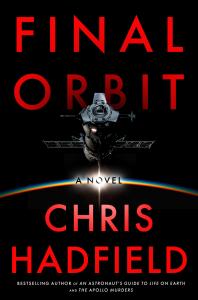
Houston, 1975. A new Apollo mission launches into orbit, on course to dock with a Russian Soyuz craft: three NASA astronauts and three cosmonauts, joining to celebrate a new dawn of Soviet-American cooperation. But as NASA Flight Controller Kaz Zemeckis listens in from Earth, a deadly accident onboard the orbiting spacecraft changes everything.
Meanwhile, from a remote location in east Asia, the first Chinese spacecraft secretly launches. On board is China’s first astronaut, Fang Kuo-chun, whose mission puts him on a collision course with the Apollo crew.
As Kaz races against an enemy on the ground and for answers beyond the sky, the safety of the remaining crew hangs in the balance…