A Conversation with Cynthia Pelayo, A Prolific Voice in the New Wave of Horror
Novel Suspects: Your books are generally set in Chicago, follow a serial killer/missing persons case, and/or pull themes from fairy tales. To someone unfamiliar with this work, they might find these combinations surprising, but these are three themes you blend beautifully. What inspires you to keep revisiting similar settings, themes, or stories?
Cynthia Pelayo: I grew up in Chicago, and I remember growing up so much media was really centered on the coasts, Los Angeles or New York. Yet, Chicago is this really wonderful city with this rich history, amazing architecture, wonderful immigrant communities and fantastic neighborhoods that I really wanted to see represented.
Growing up, like most children, many of the stories told to me by my parents were fairy tales, and those just became a part of my life. My father would buy me the Little Golden Books and we’d read those together, and some of the fondest memories I have from being a child were those fairy tales. Fairy tales gave me a sense of comfort, and hope, but many of them also started off quite dreadful and so it was wonderful to see how things would resolve through magic. Of course, when I got older, I studied fairy tales during my MFA and learned they are indeed quite grim than what I was reading as a child.
So to me, Chicago just feels like this perfect setting for a fairy tale. We have so much legend and myth here. We have Al Capone. We have H.H. Holmes (America’s first serial killer). We have L. Frank Baum who wrote parts of The Wonderful Wizard of Oz in Humboldt Park. We have Walt Disney who was born here, and whose house is in walking distance from my house. It just seemed a perfect fit, a city full of magic and history being the perfect place to explore fairy tales.
NS: You’ve spoken previously about making the change from working in the corporate world to getting your MFA and working full time as a writer. You even won the Bram Stoker Award while still working a regular 9-5. Do you have any advice for young or first-time writers who are trying to balance work with their passion? When did you know for sure that you wanted to write full time?
CP: To anyone working full-time and writing, I understand the exhaustion, trust me. The exhaustion, I’m sorry to tell you, does not dissipate when you move to working writer. I work harder now than I have ever worked in my life, because as a working writer you’re a small business owner. You’re an entrepreneur. Your business is you and your writing and you have to think about things strategically and there are a lot of aspects to being a working writer that one needs to start thinking about now, from accounting to marketing and so on.
Overall, some advice to those working full-time –
Write when you can. Life is busy as it is. Do not fault yourself for not having the perfect place to write or the most aesthetic set up or even the best cup of coffee that morning. Just write. You have to incorporate writing into all aspects of your life, and what does that mean? That means have notebooks with you. Jot down a line here or there that resonates. Listen to music. Take in art whenever and wherever you can. Write a few lines here or there. The point is, you have to become a total artist and writer, fitting in creativity whenever you can with your busy schedule.
I think by the time I made nearly twenty years in the corporate world, I sat back and just said ‘I’m not happy. This is great. I have a wonderful title. I’m accomplished in my field, but this isn’t life.’
I wanted a life based around beautiful things, around creativity and I really just wanted the independence to work for myself and be my own boss.
NS: There is a natural, poetic, and vivid nature in your writing style. When creating scenes and stories, how do you anchor yourself into the moment you are writing?
CP: I’m a poet and when I’m writing I think about how everything will sound to the ear. I read my work aloud and I want a sort of musicality to everything. It is jarring or perhaps frustrating to those people who may be more comfortable or more familiar with reading commercial fiction in which everything is just a beat of action to a response to a reflection to a pivot, but then here I am going on a long, musing and philosophical tangent about a sculpture or the collective consciousness and Carl Jung. So some readers of my work find it perplexing and may say things like ‘This is not what a novel should be’ but then I argue ‘What should a novel be and who is it that can dictate that definition?’ I really want to play with form and structure and experiment with art. That is a tricky space to be in as a traditionally published author, but so far I’m making it work.
In terms of overall anchoring, my life is a bit hectic with children and my children have disabilities so I write whenever and however I can. Usually, when I want to write a scene that feels very liminal or in this mystical flow state, I tend to want to write those very late at night, three am or four am when I’ve been up for a very long time. It gives these scenes this sort of Alice in Wonderland effect and the poetry of those movements really comes through, perhaps because I’m in this weird sort of dream and awake state.
NS: Your regular series on Threads updates followers about your writing and personal life. Can you share how you came up with the series and how it has helped you personally and/or professionally?
CP: I’m a little bit chaotic on social media, but I at least hope there’s some delight to it. I’m pretty filter free–and that gets me in trouble sometimes–however, being filter free has certainly brought me to this point in my life.
I just feel big. I’m very passionate about things, and I get frustrated by the American culture of Puritan silence or faux niceties when there are things that are beneath the surface that must be said or discussed.
So I very often tackle a lot of things on my social media, from one learning to stand up for themselves and establishing boundaries, especially for those of us who are very online. I am an advocate for disability rights and speak frequently about special education and advocating for funding and services for the disabled. I also talk about reading and writing and the teaching of writing. I also talk about art and technology and literacy and how online spaces are certainly shifting how art is created, consumed and interpreted.
I wish I could be more polished and choose one thing, but these are the things that I’m very passionate about, so I talk about them to varying degrees. Being very on social media can make one a target of a variety of things, and I’ve been there, so I like to provide my lived experiences and give very firm advice so people can avoid any missteps. Protecting children, special education, and disabilities rights will always be close issues to my heart so I will speak about them forever. And of course art, my entire life is based on living an artistic life, and I think daily about what that means, what does it mean to have this privilege to create, what should I create, how do I give back to the community with art, and ultimately, what do I want to leave behind for my children.
Discover More From Cynthia Pelayo
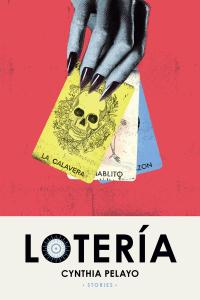
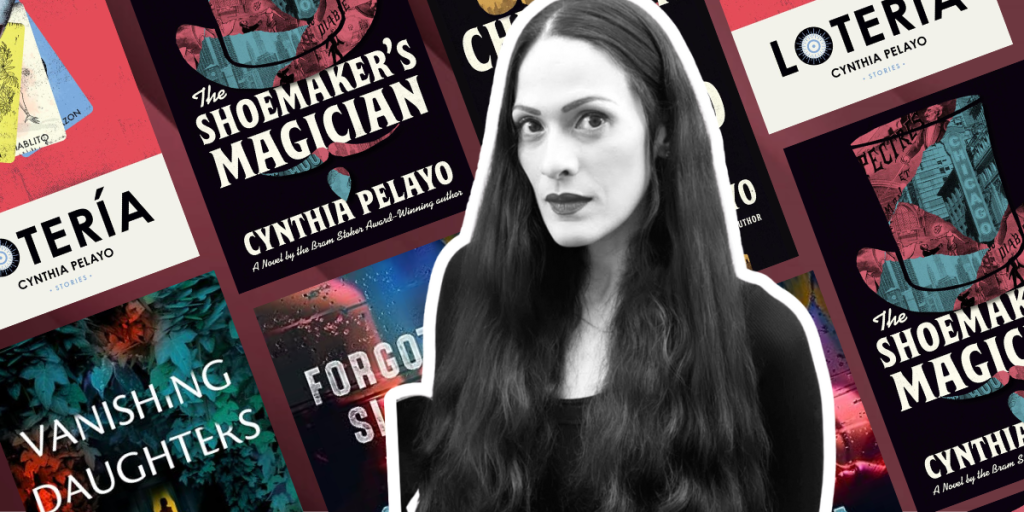
There are 54 cards in the Lotería game, and for this short story collection you will find one unique story per card based on a Latin American myth, folklore, superstition, or belief—with a slant towards the paranormal and horrific. In this deck of cards you will find murderers, ghosts, goblins and ghouls. This collection features creatures and monsters, vampires, werewolves and more.

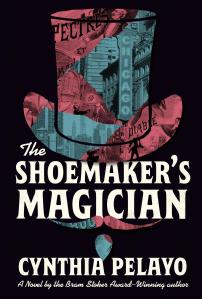
Paloma has been watching the Grand Vespertilio Show her entire life. Grand, America’s most beloved horror host, showcases classic, low-budget and cult horror movies, but Paloma has noticed something strange about Grand. After Paloma’s husband, a homicide detective, discovers an obscure movie poster pinned on a mutilated corpse, she knows that the only person that can help solve this mystery is Grand. When another body appears at an abandoned historic movie palace, the deaths prove to be connected to a silent film, lost to the ages, but somehow at the center of countless tragedies in Chicago. Paloma soon becomes trapped between protecting a silent movie that’s contributed to so much death in her city and the life of her young son
The nightmares of a woman in white pleading to come home, music switched on in locked rooms, and the panicked fear of being swallowed by the dark…Bri has almost convinced herself that these stirrings of dread are simply manifestations of grief and not the beyond-world of ghostly impossibilities her mother believed in. And more tangible terrors still lurk outside the decaying Victorian greystone.A serial killer has claimed the lives of fifty-one women in the Chicago area. When Bri starts researching the murders, she meets a stranger who tells her there’s more to her sleepless nights than bad dreams–they hold the key to putting ghosts to rest and stopping a killer. But the killer has caught on and is closing in, and if Bri doesn’t answer the call of the dead soon, she’ll be walking among them.