What We Can Learn from Classic Thrillers when Crafting Our Own Stories
When I think of the classic thriller, I can’t help but immediately think of Alfred Hitchcock. His ordinary settings always had something dangerous lurking beneath the surface (hello, completely average roadside motel). His pacing was masterful, whether it be the constant action of North by Northwest or the slow, suspenseful buildup of Vertigo. There’s so much we can learn from Hitchcock when crafting our own stories, especially when it comes to characters, which I personally believe are the most important part of every story.
Unpopular opinion (maybe): The most exciting plot in the world will bore your readers if the characters stink, but a lackluster plot can be riveting with great characters. For your reader to care about your plot, they have to care about the characters. But how do you make your audience care about your characters? First of all, they should be multifaceted. Hitchcock knew this better than anyone. His heroes aren’t always perfect and moral in every way, and sometimes his villains are charming and likeable. Take Scottie in Vertigo. Yes, he’s a great character, but he’s also very flawed. He allows himself to fall into unhealthy obsessions with women he barely knows—obsession that turns deadly. His major flaw is really what drives the story, just as it does in my own story, The Drowning Game.
Another important thing that Hitchcock understood about character is that characters must change, even if it’s not always for the better. Scottie faces his fears at the end of Vertigo, but has he changed for the better in every way? I would say no. I think the dark, dangerous romance he went through will likely haunt him and change the way he views women forever. That being said, the romance in Hitchcock movies is never sunshine and roses. Again, it’s complicated and can also be quite dark (as in Vertigo), paranoid (as in Rebecca), and unsettling (as in Marnie). Because romance in real life is never perfect, I think we have a lot more to learn about writing realistic romances from classic thrillers than from nineties romcoms.
After character, I think one of the most important hallmarks of Hitchcock’s movies is his suspense. Based on William F. Brewer’s Structural Affect Theory, there are generally three information relationships:
1. The main character knows something the reader doesn’t.
2. The reader knows something the main character doesn’t. (Hitchcock’s preferred method)
3. Neither the main character nor the reader knows something.
Alfred Hitchcock heavily prioritized suspense over surprise and explained this with his famous “bomb under the table” example. Surprise is not knowing there’s a bomb under the table until it suddenly explodes. Suspense is the viewer knowing there’s a bomb under the table while the characters don’t. And so Hitchcock would frequently let the audience know more than the characters—sometimes, I personally feel, to a fault, as in Vertigo. About midway through the movie, a character writes a letter explaining the entire mystery, leaving the audience to only wonder now if the main character will figure it out. I’ve always felt like this was a good example of when number three would have been best—leaving both the main character and the audience to wonder what was happening. That’s why I chose to leave the reader wondering until the very end in The Drowning Game.
Still, I took so much from Hitchcock in crafting my own story—the building sense of dread, the darker tone and themes, the extremely flawed characters, the far from perfect romance, and the twist. When I first saw Vertigo about thirty years ago, the twist, more than anything else, blew my mind. And so I can honestly say The Drowning Game wouldn’t exist without Alfred Hitchcock, and especially not without Vertigo. If you’ve already seen Vertigo, you might be able to predict some of what’s coming in my own story. But if you haven’t seen it, read my book first, please. I challenge you to figure it out.
Discover the Author
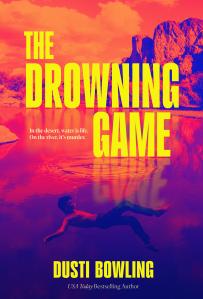
Award-winning author Dusti Bowling masterfully crafts a wild ride on Arizona’s Salt River in this Hitchcockian thriller that’s perfect for fans of Holly Jackson and Karen M. McManus.
It’s the late 1990s, and seventeen-year-old Christian is content with his summer plans to work and hang out with his cat, when he gets a phone call from his best friend that will change his life forever. James invites Christian to Arizona for a whitewater rafting trip, even though he knows Christian is terrified of water. But James is persuasive, and Christian relents.
In Salt River Canyon, the heat is scorching, and so is James’s pretty girlfriend, Freya. However, something seems off between the couple as bitter words fly. When James and the others disappear in the second raft, Christian and Freya are left to face the rapids alone. Disaster strikes when Freya falls into the river, and Christian is frozen with fear.
One year later, Christian is still wracked with guilt over Freya’s death. Now, he’s a freshman at Arizona State University, and he thinks he sees Freya on campus. It can’t be her. Freya is dead, after all. They found her body. Didn’t they? Christian follows Madison, the girl who looks like Freya, everywhere. He was certain Freya had died that day, but now he’s certain Madison is Freya. Will he ever find out what’s real? Or will his obsession be his downfall?